Most learning platforms are built to report up, not to be used
Most large organisations have a learning management system. Far fewer have one their people actually use.
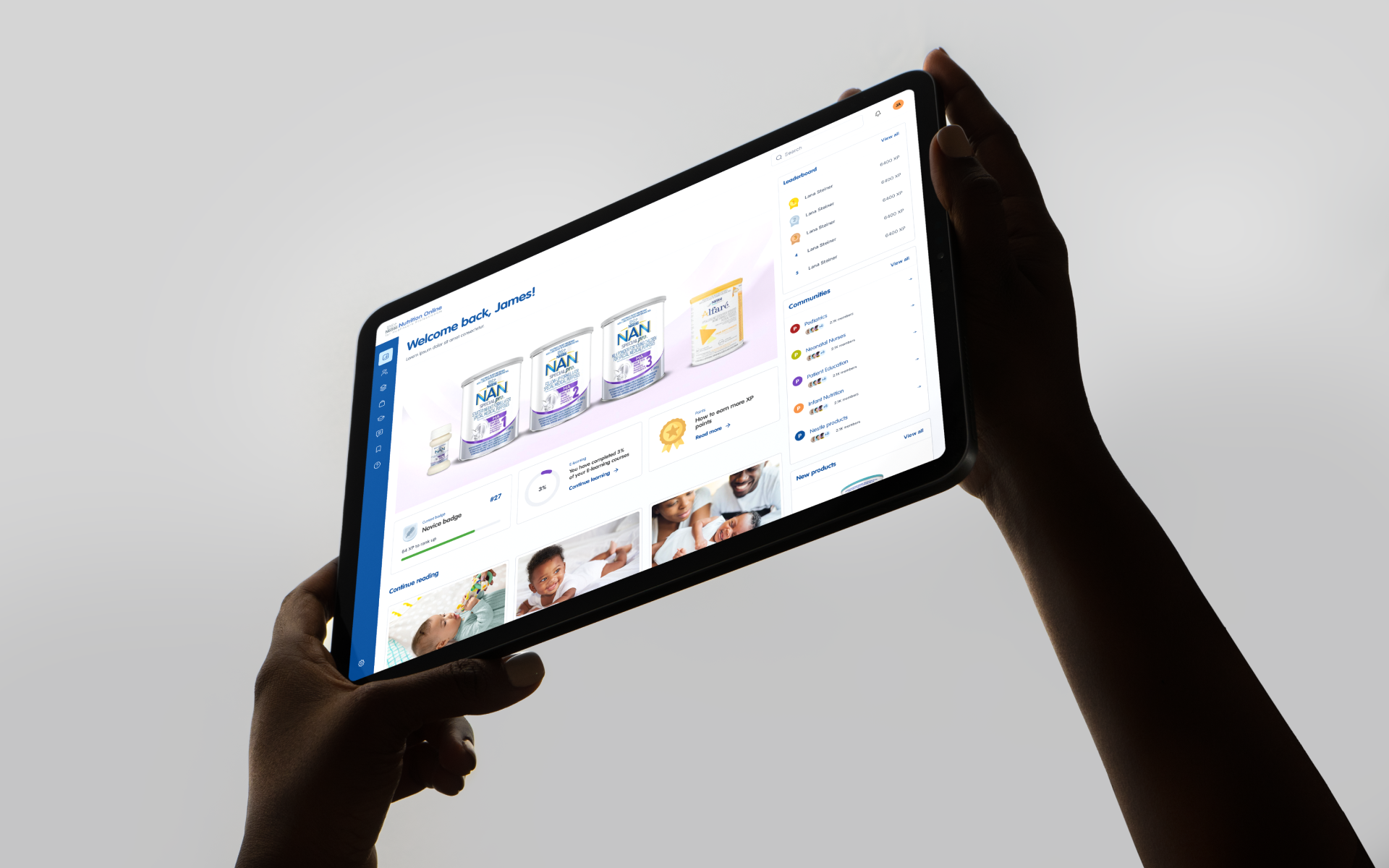
We've been thinking about this since working on a platform for Nestlé, where the brief centred on healthcare practitioners and substantive medical content rather than internal compliance reporting. That distinction, between a platform built for the people learning and a platform built for the people measuring learning, has stayed with us. It shows up in almost every LMS conversation we have.
On paper, most LMS platforms tick the right boxes. Courses are uploaded. Progress is tracked. Completion rates are reported. The issue isn't capability. It's that the underlying logic of these platforms is reporting, not learning. They're optimised for a dashboard somewhere upstream, not for the experience of the person clicking into module three on a Tuesday afternoon.
That changes what gets prioritised. Content gets loaded in volume. Navigation gets organised around administrative categories. Progress gets reduced to a percentage bar. None of these are wrong, but together they describe a system, not a product. And employees can tell the difference.
The measurement problem
Completion rates are easy to report. They're also a weak proxy for what most organisations actually want from a learning platform: changed behaviour, retained knowledge, and a workforce that returns to the platform when they need it.
A high completion rate can sit alongside very low engagement. People finish modules to clear them. The number goes up. The learning, in any meaningful sense, often doesn't.
This isn't an argument against measurement. It's an argument for measuring the things that indicate whether a platform is working as a product: return visits, time spent in optional content, peer interaction, the rate at which people recommend modules to colleagues. These are harder to capture, but they're closer to the truth.
What changes when you treat an LMS as a product
The platforms that work are the ones built with the same care given to consumer products. That doesn't mean copying the surface features of consumer apps. It means borrowing the underlying discipline: a clear user, a clear job to be done, and a willingness to cut anything that doesn't serve either.
In practice, this changes a few things:
Gamification becomes useful only when it reflects something the learner actually values. Badges and points awarded for completion alone tend to feel hollow. The same mechanics, applied to genuine progress markers, can support motivation rather than substitute for it.
Community shifts from a feature to a structural choice. Most LMS platforms treat learning as a solo activity with optional comment threads attached. The platforms people return to are usually the ones where seeing other learners, asking questions, and contributing back is part of the core flow, not a side panel.
Reward structures need to motivate without pressuring. Streaks, deadlines, and leaderboards work in some contexts and corrode trust in others. The right answer depends on the audience and the content. The wrong answer is to apply the same pattern everywhere because it tested well in a different category.
The opportunity
Most organisations don't need a new LMS. They need to stop thinking of their LMS as a system and start thinking of it as a product. That shift is small in language and significant in practice. It changes who the platform is designed for, what gets measured, and which decisions get made when something has to give.
The best learning platforms we're seeing borrow more from consumer products than from corporate tools. Not in their visual language, necessarily, but in their seriousness about the user. That's the move worth making.